WELHAUSEN SCHOOL · COTULLA, TEXAS
Before the White House,
there was Welhausen.
Cotulla’s Mexican American students were part of a lesson Lyndon Johnson carried into the presidency: opportunity meant little when poverty and prejudice kept education out of reach.
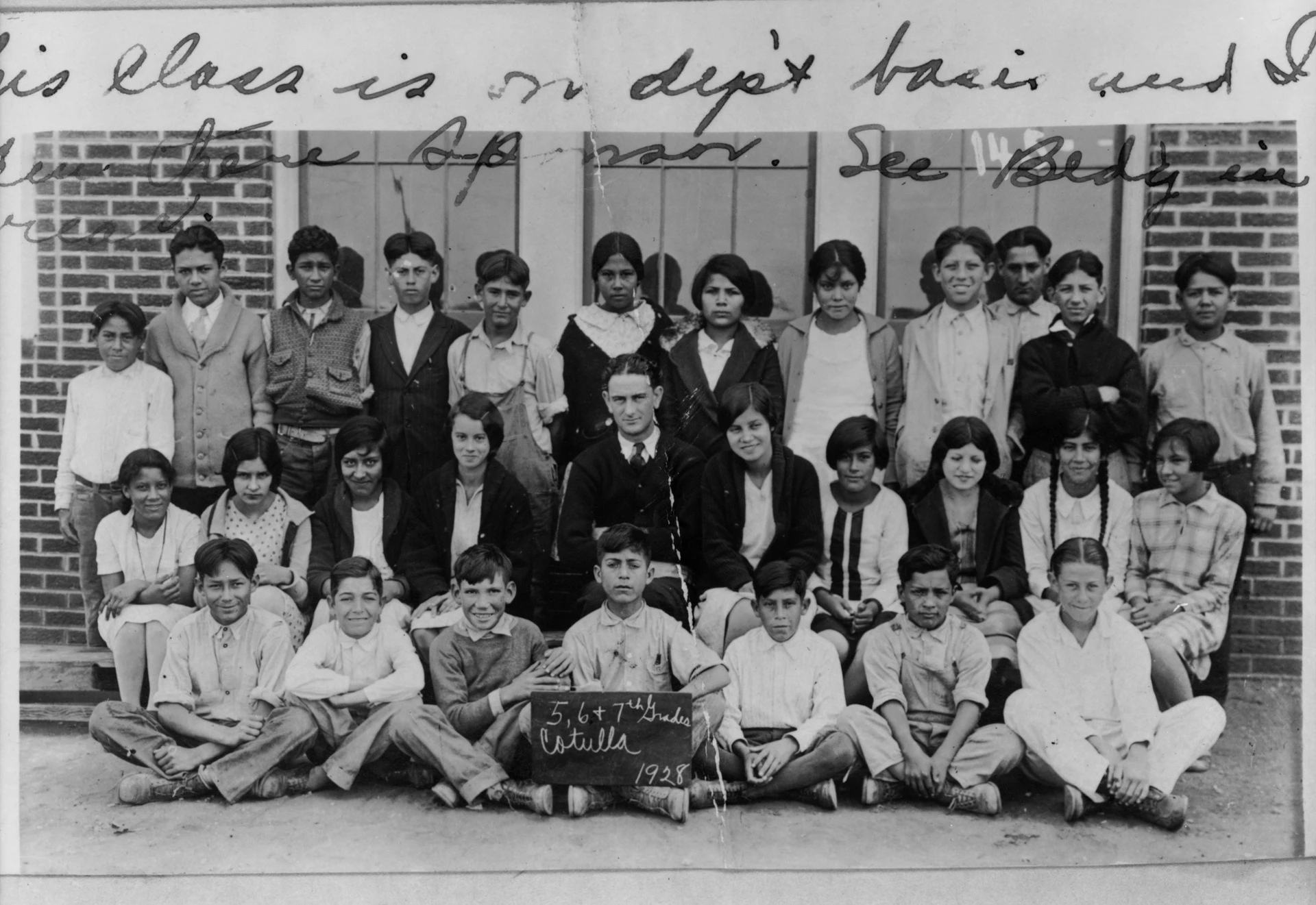
In 1928, Johnson interrupted his college studies in San Marcos to earn money teaching in Cotulla. Welhausen served Mexican American children in a segregated school system. The National Park Service describes a nine-month experience that brought him face to face with hunger and unequal opportunity. [1]
He taught fifth, sixth, and seventh grades and became principal. His work extended into debate, spelling competitions, sports, and organizing rides to events. Those activities depended on other people, too, including local car owners who transported children when the school had no buses. [2] NPS also records his purchase of athletic equipment from his first paycheck and a program to provide children with a daily meal. [1]
This is a community story as much as a presidential one. The school, its families, and its students already had aspirations of their own. In his 1966 return address, Johnson thanked Cotulla for its investment in the building and its teachers, and acknowledged former students who had gone on to college. [5]
The building, the speeches, and preservation today
Preserving the students’ story
Latinos in Heritage Conservation included Welhausen Mexican School on its 2026 Endangered Latinx Landmarks list. The organization calls attention to both the building and the memories of Mexican American children educated there under segregation. As alumni grow older, preserving their firsthand accounts matters alongside caring for the school itself. Read the preservation profile ↗
A school with a history of its own
A municipal bond approved the school in 1926. Named for La Salle County Judge G. A. Welhausen, the red-brick building was designed by Charles H. Page, with an arched entrance and decorative tile. The LBJ Museum records its later use as a primary school following Cotulla’s integration in 1970, its departure from school use in the early 1980s, and its designation as a state historic landmark in 1990. [2]
When Cotulla entered the national conversation
- March 15, 1965 · Washington, D.C.
In “The American Promise,” his appeal to Congress for voting-rights legislation, Johnson recalled his students’ hunger and experience of prejudice. He linked that memory to the opportunity he now had to help their children and others across the country. [3]
- November 8, 1965 · San Marcos
Johnson signed the Higher Education Act at his alma mater. The law expanded federal support for higher education, including scholarships and student loans. His remarks again remembered the Welhausen children and the financial barriers to college. The signing took place in San Marcos. [4] [2]
- November 7, 1966 · Cotulla
He returned to Welhausen as president, speaking to former students and local families. He described his roles as teacher, principal, coach, and playground supervisor, then called for better educational opportunities for Mexican American children. [5]
Continue the story at the Brush Country Museum ↗, whose exhibits include Welhausen and Johnson’s students. Call (830) 879-6429 for museum visiting arrangements. Interior access to the school itself is not confirmed.
Sources & further reading · 5 references
- National Park Service: Lyndon B. Johnson the Teacher ↗Teaching, segregation, student needs, and school activities.
- LBJ Museum of San Marcos: LBJ in Cotulla ↗School history, classroom work, and the 1965 recollection.
- LBJ Presidential Library: The American Promise ↗Primary source · March 15, 1965 speech.
- LBJ Presidential Library: Higher Education Act ↗Signing location, date, and archival materials.
- American Presidency Project: Return to Welhausen ↗Primary source · November 7, 1966 address.